South Florida Local News
August launches Florida’s child safety awareness month with renewed focus on protecting students

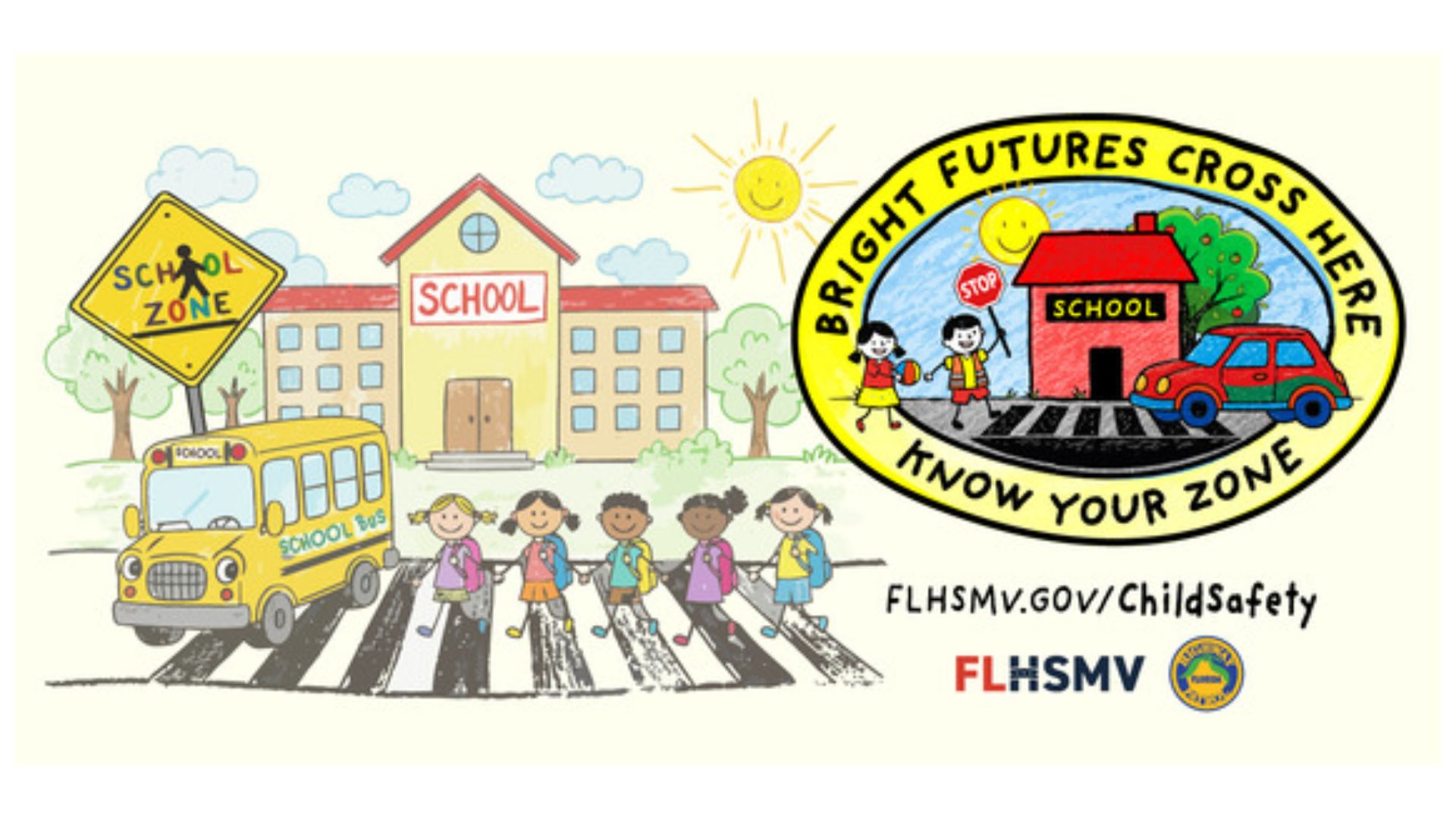
Tallahassee, Florida – As Florida families prepare for another school year, state officials are using August to remind drivers, parents, caregivers and children about the dangers that can arise around school buses, school zones and neighborhood streets.
The Florida Department of Highway Safety and Motor Vehicles has launched its Child Safety Awareness Campaign, encouraging Floridians to “Know Their Zone” and pay close attention to areas where children walk, ride bicycles, wait for buses or are picked up and dropped off. The campaign comes as students across the state return to classrooms and daily school routines become part of the morning and afternoon traffic.
FLHSMV, along with the Florida Highway Patrol and public safety partners throughout Florida, is asking motorists to make child safety a priority. Officials say every driver has a role in preventing crashes and protecting children, whether they are driving through a school zone, approaching a bus stop or simply moving through a residential neighborhood.
The campaign goes beyond reminders about slowing down near schools. State officials are also highlighting the importance of properly using child restraints and seat belts, practicing pedestrian safety, preventing children from being left in hot vehicles and avoiding dangerous backover incidents.
One of the most serious concerns is drivers passing stopped school buses. Passing a school bus is more than a violation of traffic rules because children may be crossing the road or entering and leaving the bus at the exact moment an approaching vehicle goes by.
Florida lawmakers took steps in 2023 through House Bill 0657 and Senate Bill 0766, which created and amended state laws allowing local governments to use school zone speed detection systems and school bus passing infraction detection systems.
The state is also reminding drivers that speeding remains the most common traffic violation connected to school and child safety. More than 54,000 unlawful speeding citations were issued in work or school zones across Florida during 2025.
Read also: Blaise Ingoglia visits Duval County on ninth stop of statewide hurricane preparedness tour
Drivers approaching school zones should watch for reduced speed limits and slow to the posted 15 to 20 mph when amber lights or flashing beacons are active. These warnings typically operate beginning about 30 minutes before and after the school day and during school sessions. Fines for violations in these areas are doubled.
Drivers should also yield to pedestrians and watch carefully for children near schools, buses, bus stops and parking lots. Drop-off and pickup should take place only in authorized areas.
Florida has also increased the penalties for failing to stop for a school bus. Since January 2021, penalties for failing to stop and for passing a stopped school bus on the side where children enter and exit have doubled.
Passing a stopped school bus on the left side carries a minimum fine of $200. A second offense within five years can result in a driver’s license suspension of up to one year.
The consequences are even more serious when a driver passes on the right side, where children enter and leave the bus. That violation carries a minimum $400 fine, requires a mandatory court hearing and may result in points being added to a driver’s license. A second offense within five years can lead to a suspension of up to two years.
Distraction is another major concern as students return to school. Handheld wireless device use is illegal in school crossings, school zones and active work zones, and distracted driving continues to contribute to crashes.
Read also: Florida beachgoers urged to protect sea turtle hatchlings and shorebirds during the holiday weekend
In Florida, a crash occurs every 44 seconds, while one in seven crashes is caused by distracted driving. Officials are encouraging parents to talk with their children about safe behavior around school buses and in school zones, while drivers are urged to put away their phones and concentrate fully on the road.
Pedestrian safety is another central part of the campaign. Children should use sidewalks whenever they are available. When there is no sidewalk, pedestrians should walk facing traffic so they can see vehicles approaching.
Crossing the street should be done at corners or marked crosswalks whenever possible. Children should remain alert, avoid distractions such as headphones and phones, and wait for vehicles to stop before entering the road. Making eye contact with drivers can also help ensure that motorists see them.
Children should never walk into the roadway from between parked vehicles. If crossing in the middle of a block cannot be avoided, pedestrians should yield to oncoming traffic. Bright or reflective clothing can make pedestrians easier to see, particularly at night, when carrying a flashlight is also recommended.
Heat safety is another issue Florida families cannot afford to overlook. As school schedules change, parents and caregivers are encouraged to develop habits that ensure every child has left the vehicle before the driver walks away.
Officials suggest placing something needed, such as a purse or phone, in the back seat as a reminder to check the vehicle before leaving.
Florida’s heat can quickly turn a vehicle into a dangerous environment. Temperatures inside a vehicle can rise by as much as 20 degrees in only 10 minutes. Children are especially vulnerable to heatstroke, which can occur even when the temperature outside is only 57 degrees.
Leaving a child unattended in a vehicle is a second-degree misdemeanor punishable by a fine of up to $500. If an injury occurs, the offense becomes a third-degree felony.
Anyone who sees a child or pet trapped inside a hot vehicle should call 911 immediately. Florida law allows bystanders to take action to rescue a vulnerable person or animal. To help prevent children from accidentally entering or becoming trapped in vehicles, drivers should keep vehicles locked and store keys where children cannot reach them.
The campaign also focuses on preventing backover crashes. Children should be taught not to play in or around vehicles and to move away when a driver gets into a car. Toys, bicycles and other objects should be kept away from driveways and areas where vehicles operate.
Before reversing, drivers should walk around the vehicle and check the area. Young children can be particularly difficult to see, so nearby children should be told to remain in a location where the driver can clearly see them.
Drivers should reverse slowly, check mirrors, look behind the vehicle and, when possible, roll down windows to listen for activity. Rear-view cameras and detection systems can provide useful assistance, but officials stress that these technologies are not substitutes for physically checking the area.
The return to school brings familiar routines, but it also creates new traffic patterns and more activity around roads, parking lots and neighborhoods. FLHSMV’s campaign is designed to keep those risks in focus throughout the month and encourage safer habits that can continue well beyond the first weeks of school.
For Florida families, the central message is simple. Slowing down, staying alert, using proper restraints, watching for pedestrians, checking vehicles before backing up and never leaving children unattended in hot cars are small actions that can prevent serious injuries and save lives.



August launches Florida’s child safety awareness month with renewed focus on protecting students

Florida beachgoers urged to protect sea turtle hatchlings and shorebirds during the holiday weekend

Blaise Ingoglia visits Duval County on ninth stop of statewide hurricane preparedness tour

Pompano Beach to mark the 25th anniversary of 9/11 with an evening of remembrance

Roy Rogers Seawall Project brings major waterfront improvements and stronger public access to Pompano Beach

Pine Crest student-athlete Julia Hlatki selected to 2026 U.S. Girls’ U15 Youth National Lacrosse Team

West Palm Beach announces final 2026 session of The Next Level PANEL focused on leadership and lasting community impact

Fort Lauderdale issues traffic advisory ahead of Labor Day Festival scheduled for September 6

World’s largest contract logistics provider GXO Logistics to establish new regional office in Fort Lauderdale

Weston at 30 history podcast launches September 3 with stories from the city’s early years

Snook recreational harvest season opens September 1 across most of Florida

Fort Lauderdale United FC and Gainbridge support South Florida families with $9,900 YMCA donation

Oakland Park opens new Greenleaf Park downtown with basketball tennis pickleball and family recreation spaces

Pembroke Pines prepares for its 3rd Annual Hispanic Heritage Festival with music food and cultural celebrations

Sewer pump station B-4 improvements continue as additional rehabilitation work pushes completion into early 2027
-
 South Florida Local News4 days ago
Weston at 30 history podcast launches September 3 with stories from the city’s early years
-
 South Florida Local News4 days ago
Snook recreational harvest season opens September 1 across most of Florida
-
 South Florida Local News4 days ago
Fort Lauderdale United FC and Gainbridge support South Florida families with $9,900 YMCA donation
-
 South Florida Local News2 days ago
World’s largest contract logistics provider GXO Logistics to establish new regional office in Fort Lauderdale