State
Attorney General James Uthmeier announces 81-year prison sentence for career criminal who used drones to traffic drugs into Florida prisons

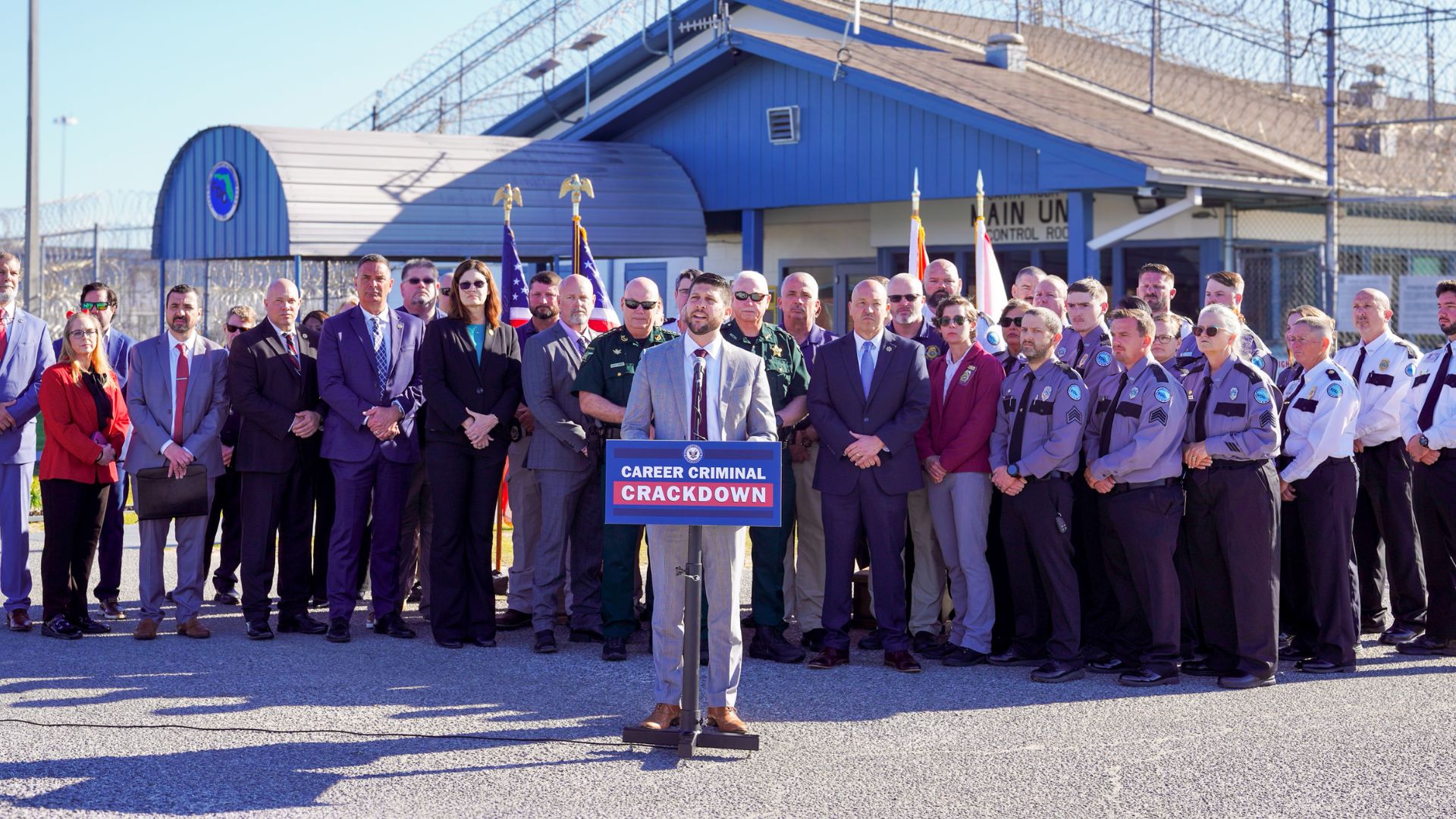
Tallahassee, Florida – In a significant victory for law enforcement and prison safety, Florida Attorney General James Uthmeier announced that a Jacksonville man has been sentenced to 81 years in prison for orchestrating a sophisticated drug trafficking scheme targeting state correctional facilities. The case, which has drawn attention for its use of modern technology to smuggle contraband, underscores the state’s commitment to combating career criminals who threaten public safety.
Mario Crawford, 36, a career criminal with a staggering record of 49 prior convictions, was found guilty of using drones to deliver drugs and contraband into Florida Department of Corrections facilities. Authorities say his criminal activity spanned multiple correctional institutions, putting both staff and inmates at significant risk. Items recovered included cocaine, methamphetamines, cell phones, SIM cards, charging cords, tobacco, and even razor blades, a combination that officials say could have led to serious harm if introduced into the facilities.
“Trafficking drugs and razor blades into our prisons puts the lives of Florida’s corrections officers at risk, and that risk is not something we are going to tolerate,” Attorney General Uthmeier said. “Someone with 49 prior convictions for dangerous crimes should’ve never been allowed to walk free again, but my office is cracking down on career criminals, and he will spend the rest of his life behind bars. I thank Secretary Dixon, his team, and our Statewide Prosecutors for their commitment to justice and the safety of Floridians.”
The investigation began on September 22, 2022, when officers at Century Correctional Institute discovered a crashed drone carrying contraband. The discovery prompted an immediate investigation in which law enforcement officials worked closely with the Federal Aviation Administration to trace the drone back to Crawford. The high-tech nature of the crime, combining drones with illicit deliveries, highlighted the growing threat of drone-facilitated criminal activity, particularly in secure environments like prisons.
Florida Department of Corrections Secretary Ricky Dixon emphasized the dangers posed by drones entering correctional facilities. “The criminal use of drones is a growing crisis that demands immediate action if we want to keep our officers and institutions safe. I’m thankful for Attorney General James Uthmeier and our law enforcement partners who recognize this security threat from above, and are committed to helping us thwart this dangerous criminal enterprise,” Dixon said. “The impact of eliminating these threats cannot be overstated, and Florida will continue to lead when it comes to drone mitigation and contraband prevention.”
Crawford’s arrest in March 2023 brought relief to multiple institutions. He faced charges including Introduction or Possession of Contraband at a State Facility, Conspiracy to Introduce or Possess Contraband at a State Facility, Trafficking in Over 10 Grams of Cathinone, Illegal Use of a Drone, and Use of a Two-Way Communication Device to Facilitate a Felony. Investigators also linked additional deliveries to Liberty Correctional Institute and Okaloosa Correctional Institute, reinforcing the extent of his operations.
“The actions dropping drugs into and around prisons endanger all the amazing staff that work inside the prison. We will continue to aggressively pursue these types of drug dealers and put them in jail,” said Bob Johnson. The sheriff praised the cooperation between state prosecutors, correctional staff, and federal agencies, noting that such collaboration is crucial for keeping prisons secure.
The trial, held in the First Judicial Circuit of Florida in Escambia County, concluded on March 12, 2026, with a jury finding Crawford guilty on all counts. Chief Assistant Statewide Prosecutor Brian Fernandes and Assistant Statewide Prosecutor Guillermo Vallejo led the prosecution, presenting evidence that linked Crawford’s prior criminal activity to the drone scheme.
Crawford’s criminal history spans more than two decades, including convictions for armed burglary, grand theft, weapons charges, fraud, and trafficking in stolen property. Officials say his repeated offenses exemplify the dangers posed by career criminals who continue to operate despite numerous prior convictions. With the 81-year sentence, Crawford is expected to spend the remainder of his life in the Florida Department of Corrections.
The case has drawn attention not only for its length of sentence but also for the innovative method Crawford used to transport contraband. Drones, which have become increasingly accessible, are now considered a serious threat by prison officials nationwide. The Florida Department of Corrections has implemented new measures for drone detection and mitigation, including specialized radar systems and enhanced surveillance, to prevent similar incidents.
Attorney General Uthmeier highlighted the broader implications of the case. “Our focus is clear: career criminals who continually put our communities at risk will be held accountable. Florida is sending a strong message that we will not allow our correctional institutions to become easy targets for illegal activity,” he said. The office of statewide prosecution has vowed to continue monitoring emerging threats, including the misuse of drones, as part of its ongoing efforts to safeguard the state’s correctional facilities.
For corrections officers, the successful prosecution of Crawford represents more than just a legal victory. It is a reassurance that the risks they face on a daily basis are taken seriously. By preventing the smuggling of drugs and dangerous items into prisons, officials say they are protecting both staff and inmates while maintaining the integrity of Florida’s correctional system.
The 81-year sentence also reflects the state’s broader approach to repeat offenders and high-risk criminal activity. By targeting individuals with extensive criminal histories who continue to engage in dangerous behavior, Florida officials hope to deter similar crimes in the future and reinforce the message that technological innovations cannot be used to circumvent the law.
“This case underscores the importance of vigilance, coordination, and the use of modern technology to protect public safety,” said Secretary Dixon. “It also demonstrates the commitment of our law enforcement and prosecutorial teams to address evolving threats before they endanger lives.”
With Crawford now behind bars, Florida authorities continue to focus on strengthening security protocols within correctional facilities and improving methods for detecting and preventing contraband deliveries. Lawmakers and law enforcement officials say that ongoing training, inter-agency cooperation, and investment in technology will be critical in maintaining safe and secure institutions.
The case of Mario Crawford serves as a stark reminder of the challenges posed by repeat offenders and emerging criminal technologies. While the 81-year prison sentence is a landmark judgment, officials emphasize that the fight against contraband, drone-assisted crime, and career criminals will continue, ensuring that Florida’s correctional system remains a secure environment for both staff and inmates.
For more information about the Florida Attorney General’s Office and ongoing initiatives to combat contraband and protect correctional facilities, visit myfloridalegal.gov.



Two Pine Crest seniors named semifinalists for 2027 Coca-Cola scholarships

West Palm Beach invites businesses to explore city grants and incentives

West Palm Beach to host free startup workshop for aspiring business owners

Boca Raton chef faces DUI and drug charges after deputies report 102 mph pursuit

Hollywood reminds residents that early voting begins October 19

Broward School Board approves free menstrual products pilot at at least seven schools

Florida permanently protects nearly 1,500 acres across two working cattle ranches

Pine Crest student Alaina Jamal earns recognition for three original poems

Fort Lauderdale opens new water treatment center as part of $666 million project

Broward commissioners approve possible legal action to access sheriff’s headquarters

Man arrested after Pompano Beach shooting leaves one person injured

Overnight lane and ramp closures scheduled on Broward highways through Oct. 29

Sinta Tantra’s Petals of the Moon brings new public art to southern West Palm Beach

DeSantis announces plans for hurricane tax-filing relief as FICPA awaits IRS confirmation

Greater Fort Lauderdale Alliance president and CEO Bob Swindell announces retirement in 2027
-
 South Florida Local News4 days ago
Overnight lane and ramp closures scheduled on Broward highways through Oct. 29
-
 South Florida Local News3 days ago
Florida permanently protects nearly 1,500 acres across two working cattle ranches
-
 South Florida Local News4 days ago
Man arrested after Pompano Beach shooting leaves one person injured
-
 South Florida Local News3 days ago
Fort Lauderdale opens new water treatment center as part of $666 million project