South Florida Local News
Chief Financial Officer Blaise Ingoglia identifies over $275 million in Jacksonville’s 2025–2026 budget

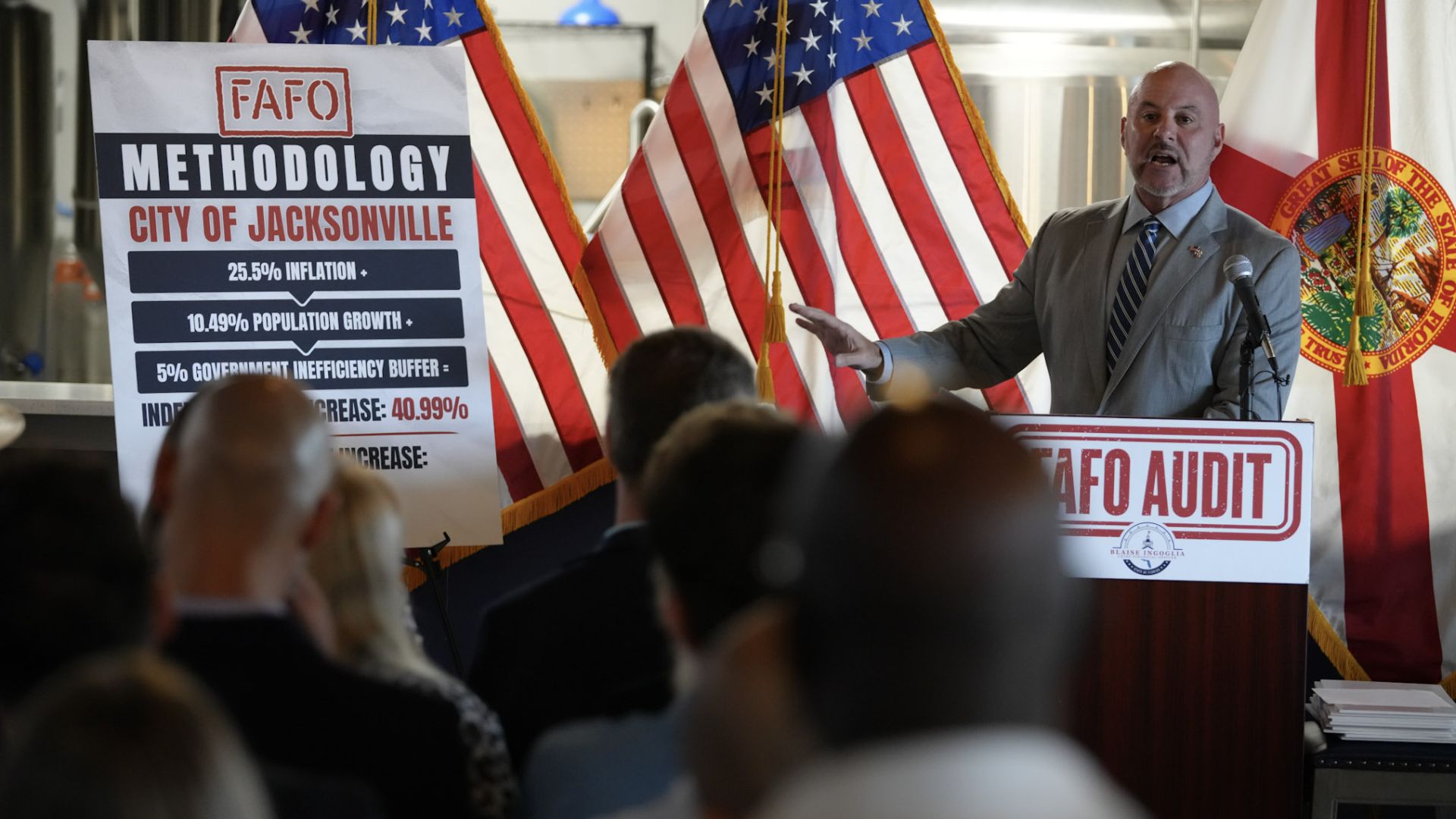
Jacksonville, Florida – Florida Chief Financial Officer Blaise Ingoglia has announced that more than $275 million in the City of Jacksonville’s 2025–2026 budget has been identified as “excessive, wasteful spending,” reigniting debate over how the city manages its rapidly expanding finances.
The review comes as Jacksonville’s General Fund Budget has grown sharply in recent years, increasing by 61% since 2019. According to state-level analysis shared by Ingoglia, the city’s spending trajectory continues to outpace population growth and raises questions about long-term fiscal sustainability.
Ingoglia has made similar claims in the past. Last year, he pointed to over $199 million in what he described as wasteful spending in the 2024–2025 budget cycle. With the latest findings, he said his office remains focused on transparency and accountability for taxpayers across Florida, particularly in fast-growing urban areas like Jacksonville.
Speaking directly about the city’s financial direction, CFO Blaise Ingoglia said, “Once again, The City of Jacksonville has proven that they do not care about taxpayers. They only care about their large, bloated, taxpayer crushing budgets. Since Mayor Deegan took office, she has continued to recklessly and irresponsibly spend taxpayer dollars. Property tax reform is not only doable, it is necessary, and Floridians will be able to choose to keep more of their hard-earned money out of the hands of government come November.”
Read also: Pompano Beach City Commission to hold budget workshop focused on Fiscal Year 2027 financial planning
The statement underscores growing political tension between state financial oversight figures and local government leadership in Jacksonville, as budget discussions increasingly focus on taxation levels, public spending priorities, and long-term fiscal planning.
Supporting Ingoglia’s position, Greg Ungru of Americans for Prosperity also weighed in on the findings, pointing to what he described as a pattern of unchecked spending at the municipal level.
Greg Ungru, Americans for Prosperity, said, “The FAFO methodology has highlighted fiscal responsibility by making sure the local government works for the constituents they serve, not the other way around. Today, the numbers have shown that Jacksonville has continued to take advantage of the taxpayers. I want to thank CFO Ingoglia for his continued oversight to mitigate overspending in local government’s budgets.”
The Florida Agency of Fiscal Oversight (FAFO) reported that Jacksonville has exceeded expected spending benchmarks by $623,438,960 over the past six years. The analysis adds another layer to ongoing scrutiny of how municipal budgets are structured and whether rising costs are justified by population and service demands.
According to the data presented, the city’s General Fund Budget increased by $840,108,313 between fiscal year 2019–2020 and fiscal year 2025–2026. During the same period, Jacksonville’s population grew by 10.49%, adding approximately 99,588 residents.
Read also: Fort Lauderdale United FC announces return of head coach Tyrone Mears
That gap between population growth and budget expansion has become a central point in the fiscal debate. Officials reviewing the numbers noted that for every family of four moving into the city, the budget increased by an estimated $33,743.36, a figure that has fueled further discussion about cost efficiency and government expansion.
State financial analysis also suggests that Jacksonville could lower its millage rate by 1.49 mills without reducing essential public services. If implemented, the adjustment would directly impact homeowners across the city, potentially offering meaningful annual savings depending on property value.
Under the proposed scenario, estimated savings would look like this:
• A taxable home value of $300,000 would save $447 per year.
• A taxable home value of $400,000 would save $595 per year.
• A taxable home value of $500,000 would save $744 per year.
These figures are being highlighted by fiscal oversight advocates as evidence that tax relief measures could be achieved without disrupting core city services, though city officials have not publicly responded to the specific calculations outlined in the report.
Ingoglia also emphasized that his broader oversight efforts are not limited to Jacksonville. He stated that his office has identified more than $2.7 billion in what he considers excessive or unnecessary spending across various government budgets statewide. His focus, he said, remains on exposing inefficiencies and pushing for greater accountability in public finance systems.
As Florida continues to experience population growth and increasing demand for public services, debates over taxation and spending are expected to intensify. Supporters of Ingoglia’s approach argue that tighter oversight will protect taxpayers, while critics of budget cuts often warn about potential impacts on long-term infrastructure and service quality.
For now, Jacksonville finds itself at the center of that larger statewide conversation, with hundreds of millions of dollars in disputed spending once again placing the city’s budget under a closer microscope.



Pine Crest celebrates 31 members of the Class of 2027 named National Merit Scholarship Semifinalists

West Palm Beach celebrates Hispanic Heritage Month with two nights of free music, dancing, food and cultural entertainment

Florida residents urged to live BearWise® and reduce conflicts with bears as fall food searches increase

Garfield Garage construction project set to begin October 1 while garage remains open to the public

New York developers pour millions into Fort Lauderdale as they bet on the city’s growing real estate market

Fort Lauderdale United FC falls 2-1 to Dallas Trinity FC despite strong second-half comeback effort

16-year-old Miami angler lands Florida state record jaguar guapote

Dog causes major mess aboard Southwest flight to Fort Lauderdale

Delray Beach man faces three drug trafficking cases after Boca Raton investigations

I-595 to I-75 express lane ramp to close overnight from September 21 through 25

Florida launches Workforce Pell Grant funding for short-term career training

Music Under the Stars returns to Pompano Beach with fall concerts

Pembroke Pines invites local dogs and their owners to the 14th annual Bow Wow Ween costume contest

Florida officials seek public input through new survey for the 2028 State Hazard Mitigation Plan

McNab Road bridge replacement in Pompano Beach gets revised November 1 reopening date after months of construction
-
 South Florida Local News5 days ago
I-595 to I-75 express lane ramp to close overnight from September 21 through 25
-
 South Florida Local News5 days ago
Music Under the Stars returns to Pompano Beach with fall concerts
-
 South Florida Local News3 days ago
Delray Beach man faces three drug trafficking cases after Boca Raton investigations
-
 South Florida Local News5 days ago
Florida launches Workforce Pell Grant funding for short-term career training